When
10/27/2026 - 12:00 am
-to-
11/25/2026 - 11:59 pm
Where
,
EdE Sinkovics – Make Upcycling Great Again
**MAKE UPCYCLING GREAT AGAIN – Artist Statement**
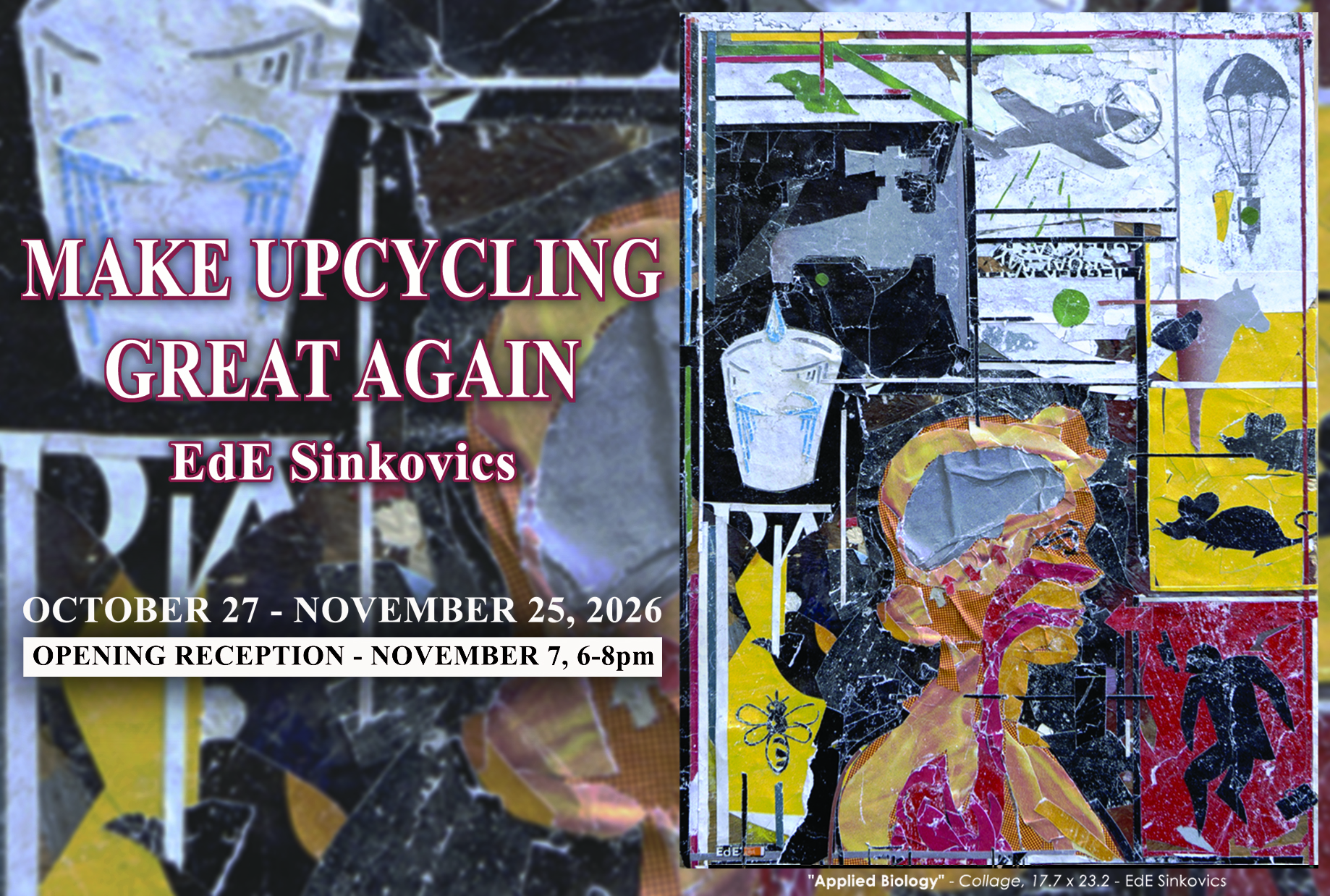
Make Upcycling Great Again is a broader presentation of my ongoing research into the world of discarded, reusable and upcyclable materials.
For many years, I have been interested in what happens when materials that have already been considered “finished” are given another chance to exist. My work has always involved forms of remake, reinterpretation and reconstruction, and over time this way of thinking has increasingly led me toward discarded materials as an artistic vocabulary.
My collaboration with TerraCycle opened an extraordinary field of research. During my years working with the company in Trenton, I had the opportunity to explore what was, for me, something like the world’s most extraordinary warehouse of unusual materials. And yes, I even found the answer to the question Douglas Adams raised in “The Hitchhiker’s Guide to the Galaxy”: where do all the missing ballpoint pens in the universe go? I found them there.
Humor has always been an important tool in my work. It allows me to enter into a dialogue with materials and difficult subjects without making the work purely didactic. I try to create objects that are visually enjoyable, sometimes funny, sometimes absurd, but also capable of staying in the viewer’s mind and provoking a second thought.
In a way, what I do could be described as a kind of visual illusion — but in a positive sense. Collecting, sorting, cleaning, processing and reconstructing discarded materials is a form of problem-solving. At the same time, it points toward a larger question: perhaps we need to change not only the materials that surround us in everyday life, but also the way we think about them.
My artistic research has long been connected to the idea of the remake. I take something that already exists and transform it, reinterpret it and give it another context. With waste materials, this becomes particularly interesting. Instead of hiding the fact that something is waste, I try to transform it into something visually compelling enough to enter our field of attention.
Perhaps it stays under our skin for a moment, remains in our eyes, and makes us think: Wait — this is waste? Can you make something like this from it? That moment of positive astonishment is important to me. I don’t want to tell people what to think. I would rather create a situation in which they discover something for themselves: that waste is not something alien to us. It comes from us.
I sometimes think of the old idea that if you shine a light on the devil, he disappears. Perhaps waste works in a similar way. Instead of hiding it, we bring it into the light. We look at it, play with it, reconstruct it and give it another context.
I grew up in the Balkans, in the atmosphere of Central and Eastern Europe, where my father had a very simple philosophy: “Don’t throw anything away. It will be good for something.” That sentence probably became one of the earliest seeds of my artistic thinking. Today, I wonder whether we should apply the same principle not only to objects, but also to ideas. Perhaps we should reuse our thoughts too. Chew them over again. Reconsider them. We don’t necessarily have to throw everything away just because it has become inconvenient or unfashionable. The process itself can also be meditative. Working with discarded materials involves enormous amounts of sorting, washing, cleaning, dismantling, preparing and assembling. These repetitive physical processes can be surprisingly humbling. They slow things down and, in a sense, reduce the ego. The material itself begins to dictate many of the decisions.
This is one reason why my relationship with upcycling has gradually moved beyond an environmental strategy and become a way of thinking and working. What began as a response to ecological challenges and everyday political realities has increasingly become embedded in my artistic practice itself. These materials are no longer simply a subject or a message. They are becoming my medium.
Over the years, this work has also brought unexpected international recognition. One of the most remarkable examples was “The Dirt of Venus”, my upcycled reinterpretation of Botticelli’s, “The Birth of Venus”, which was included by invitation in an Italian national high-school textbook.
In 2025, I was also invited by the Mayor of Budapest to present a major exhibition at the Gallery of Budapest City Hall on Earth Day. I have also conducted workshops related to these ideas in several countries.
These experiences have reinforced my belief that upcycling does not have to be presented as a moral lesson. It can be playful, beautiful, absurd, critical and intellectually engaging at the same time. Ultimately, I believe that good upcycling also acts back upon us. It reuses us, rearranges us, repackages us. It asks us to reconsider what we thought was useless — including, perhaps, some of our own assumptions and hopefully, it rearranges us in a better direction.
”Make Upcycling Great Again” is therefore not only an exhibition about what we do with waste. It is also about what waste can do to us.
EdE Sinkovics DLA